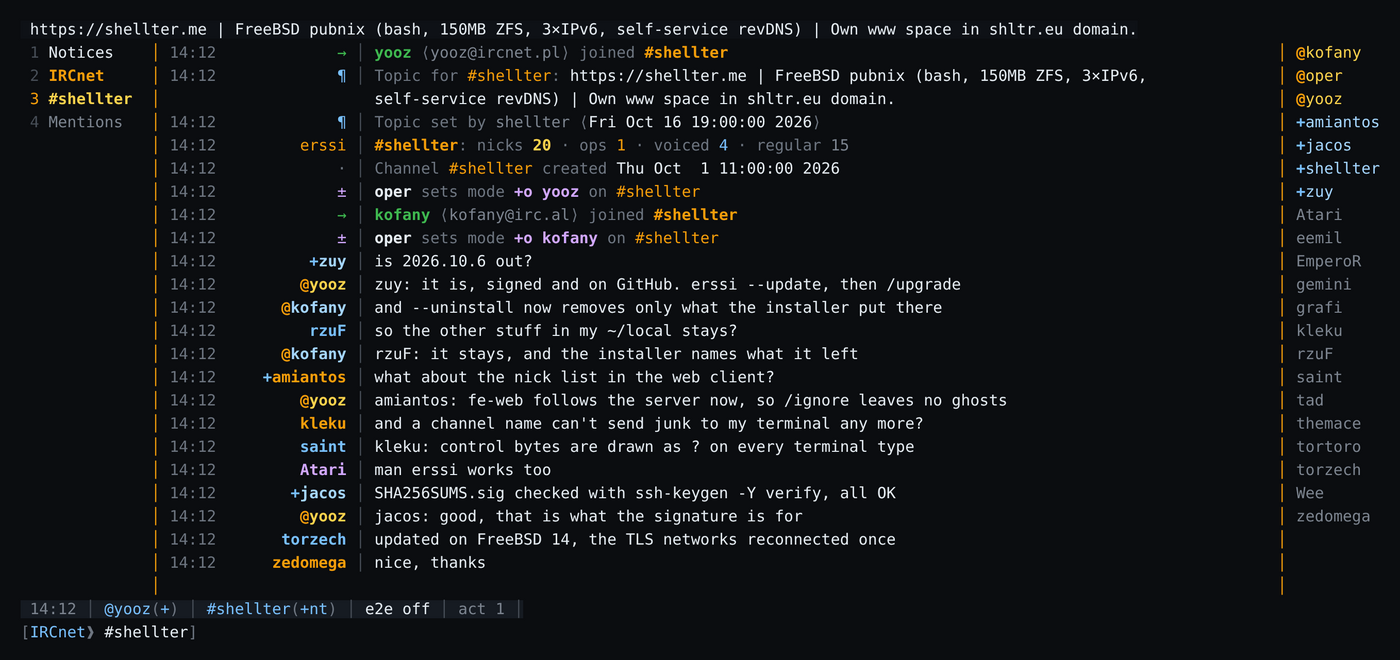
erssi 2026.10.6 in #shellter, with the real nicks of the channel. The lines they say were written for this picture.
What an IRCnet user would otherwise script
Everything erssi brings stays: side panels, mouse support, 24-bit colour, image preview, a web frontend and irssi's Perl scripts. This edition adds the rest, and every command has a page in /help.
End-to-end encryption, built in
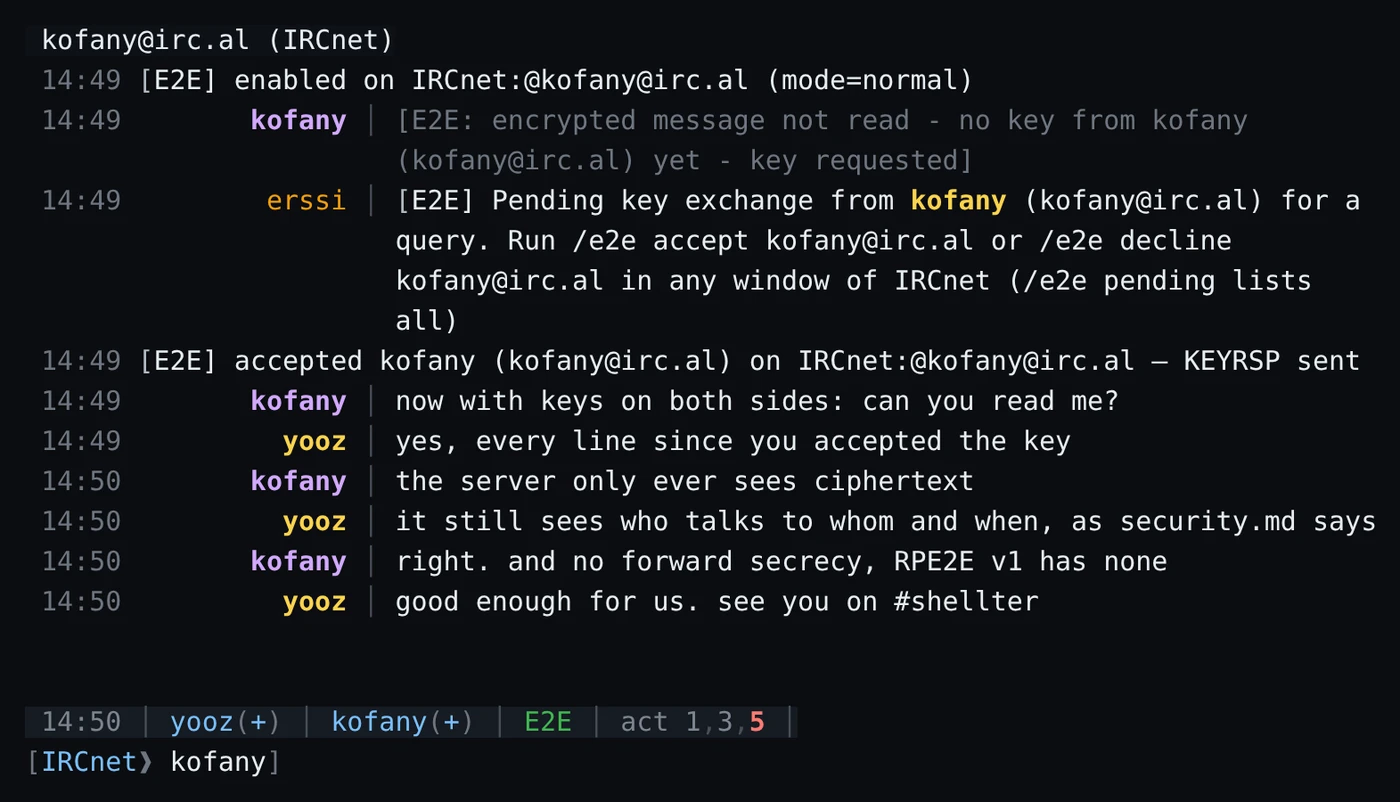
RPE2E natively, wire-compatible with repartee and its WeeChat and irssi scripts: XChaCha20-Poly1305 with per-sender keys, given only to people you accept. A message that cannot be read is never hidden. It protects what you say, not who talks to whom, and it has no forward secrecy.
A real exchange: the first message asks for the key, one /e2e accept, then everything is read.
Side panels that stay put
Your windows on the left and the channel's nicks by rank on the right. Saved layouts come back after a restart exactly as they were.
Your nick, kept
/keepnick takes it back the moment it is free: through MONITOR where the server offers it, otherwise ISON.
Mentions in one place
Private messages, notices from people and hilights in one window and a log, with a desktop notification through the terminal, also inside tmux.
One column for every line
The shellter theme puts messages, events and replies under one separator, in the colours of shellter.me; shellter-light for light terminals.
shelltershellter-light
Search your logs
/search looks through the logs of a channel or every network in a separate process, so erssi carries on.
erssi keeps running in tmux on your shell account. Reach the same session from a narrow ssh window or from a browser.
Readable on a narrow terminal. Long lines wrap and stay under the separator, even at 56 columns.
A web client when you need one. fe-web shares the session with a client such as NexusIRC; the web nick list follows the server.
Only you can open it. On a shared box fe-web listens on a Unix socket that only your account can reach.
Install in one line, update in two
Run it on your shell account. It goes to ~/.local/opt/erssi and keeps its settings in ~/.erssi, so it runs next to irssi.
1. Run the installer
It checks your system, the release's signature and the package before anything in your home changes.
curl -fsSL https://raw.githubusercontent.com/y-o-o-z/erssi/main/shellter-install.sh | sh
2. Start it inside tmux
The session survives logging out. The first start asks for a network, a nick and the theme, then connects.
tmux new -s irc erssi
3. Update when a release comes out
Then /upgrade in the running erssi keeps your windows; TLS connections reconnect once.
erssi --check-update
erssi --update
Debian 13, FreeBSD 14 and 15, amd64
A ready-made binary, in seconds, installed only when the signature on its SHA256SUMS, its checksum and its manifest check out. The previous release stays for --rollback.
Other Linux and FreeBSD systems
Built from the newest signed release, with the test suite, in about two minutes. Needs GLib 2.70 or newer; missing packages are named for your administrator.
The installer carries the release key and the commit of every release, and installs nothing that does not match. You can check the same things by hand.
Run it in a clone of the repository; gpg is switched off so that only the SSH key counts. It must report a good signature with the fingerprint on the right. Compare it with one you got another way, for example by asking on #shellter.
6 of 6: build, shellcheck, installer, e2e-live, sanitizers, fuzz
New in 2026.10.6
Released on 25 October 2026: fixes from a full review of 2026.10.5.
terminal
Nothing reaches your terminal raw. Control characters from the network are drawn as ? on every terminal type, so a channel name cannot set your clipboard or window title.
install
--uninstall removes only its own files. Libraries and man pages of other software in the same prefix stay, and the installer names what it left.
fe-web
A web frontend that holds under load. Too many new connections from one address are closed before TLS starts; new certificates get a random serial, the extensions browsers expect and 825 days.
e2e
Steadier encryption. Key requests have a budget per sender, the keyring is cached, and freed plaintext is wiped.
core
A safer /upgrade. It checks that it can write the session file first, and a failed /upgrade sends nothing twice.
docs
man erssi. A manual page of its own, linked for an install in your home.